
To Defend Democracy, Defend Labour: Why Human Rights Must Begin at Work
Written by : Mustafa Qadri, CEO, Equidem
A World in Upheaval
We are living through a convulsion of crises, climate disasters erupting with ever greater frequency, mass displacements tearing at the fabric of societies, geopolitical conflicts reshaping trade and supply chains, and authoritarian regimes tightening their grip while democratic norms fray. At the same time, technology is accelerating with breathtaking speed: automation, artificial intelligence, and surveillance systems are advancing unchecked, while the widening digital divide ensures that those most marginalized are locked out of opportunities even as their labor sustains these very systems driving growth.
These crises are too often compartmentalized; climate change discussed in one forum, tariffs and trade wars debated in another, the erosion of democracy lamented somewhere else, as though they were unrelated phenomena. In reality, they converge most sharply in the quotidian lives of working people. It is visible in the taxi driver navigating flooded streets in Bangkok; in the factory worker who loses her job overnight in Dhaka due to automation; in the migrant domestic worker enduring 16-hour days in Riyadh, and in the content moderator in Nairobi forced to absorb a relentless stream of online violence that leaves deep psychological scars, with no access to healthcare protections.
Here, at the point of collision between climate, politics, technology, and governance, we see with brutal clarity who bears the costs of disruptions and who is shielded from it. For every worker forced to gamble their health, livelihood, or dignity simply to survive, there is a billionaire whose fortune multiplies amid crisis, proof of a system that distributes suffering and reward with grotesque inequality.
Workers Building Democracy from Below
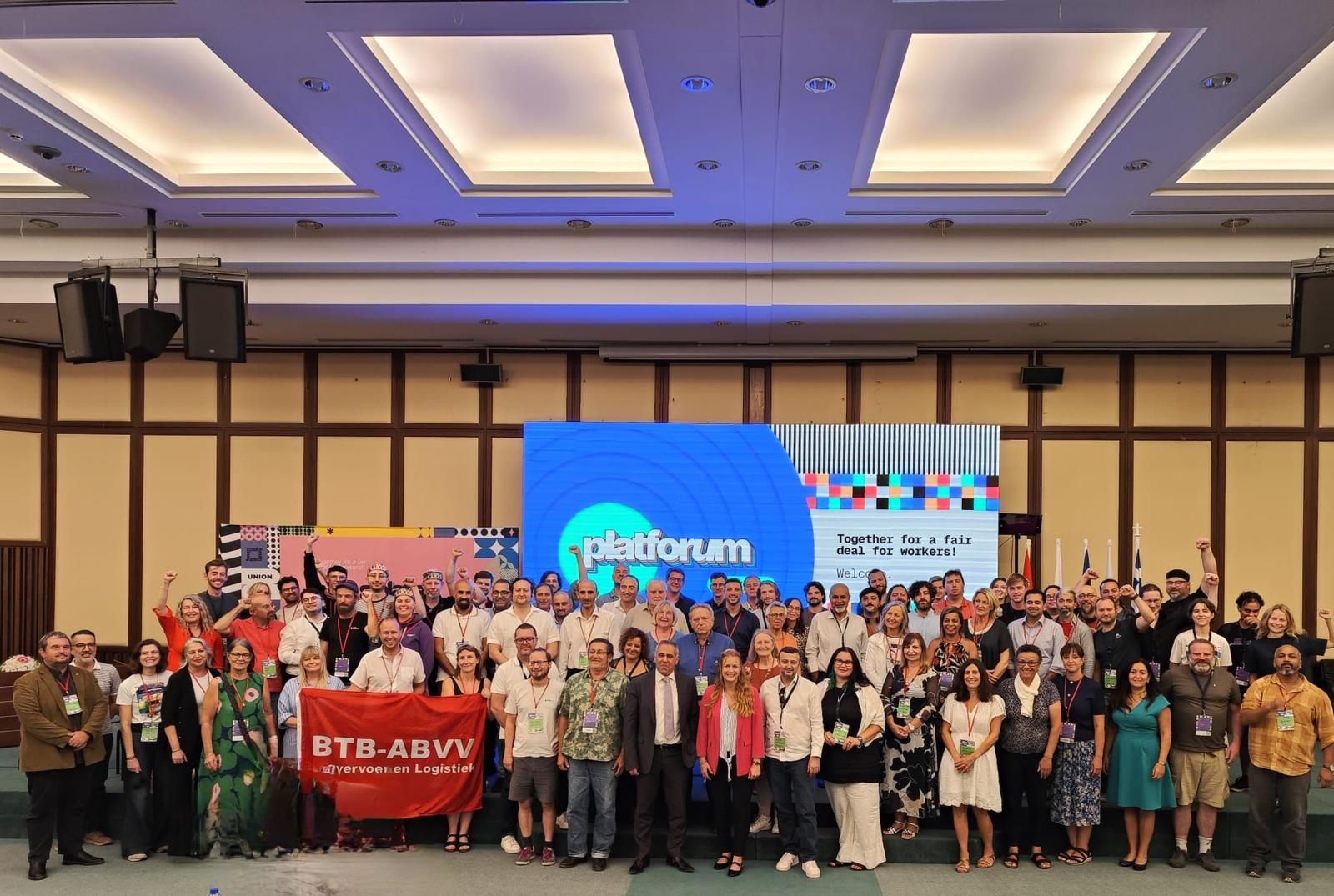
As CEO of Equidem, I had the privilege of joining two very different gatherings in the last few months, that revealed both the dangers we face and the possibilities ahead: a session we organized during the United Nations General Assembly (UNGA) in New York, and a workshop we co-hosted at the European Trade Union Confederation’s PlatForum in Nicosia.
At UNGA, we convened a dialogue at the Ford Foundation Center for Social Justice titled “Reviving Hope: Worker Organizing from Care to the Cloud.” We chose to hold this event in parallel with the General Assembly because the United Nations has so often been the global stage for advancing civil and political rights, the right to vote, to speak, to assemble. But the other half of the human rights framework, the socio-economic rights enshrined alongside them, the right to a living wage, to safe workplaces, and to freedom of association, have not always received equal attention. These rights are not secondary: without them, civil and political freedoms are difficult to sustain in practice.
For example, a precarious migrant worker on a short-term contract cannot meaningfully participate in civic life, a garment worker facing gender-based violence in her factory is silenced long before she can claim freedom of expression and an overworked nurse cannot meaningfully hold her government accountable.
It is important to remember that socio-economic rights, rights that protect any worker’s dignity, are already written into the very foundations of international law, in the Universal Declaration of Human Rights and the International Covenant on Economic, Social and Cultural Rights. Yet as economies have been reshaped around rapid growth and global capital, these rights have been steadily overshadowed. The consequences are clear: working people divided and disempowered, their vulnerability exploited, and their silence deepening the space in which authoritarianism flourishes.
Our intervention at UNGA was about resisting that erosion of human rights and pushing back through the collective strength of trade unions and civil society organizations. We sought to reclaim the United Nations and its mandate by renewing its original promise: that all rights — civil, political, economic, social, and cultural — are universal, indivisible, and interdependent. Reclaiming the UN’s foundations means moving beyond lofty declarations and anchoring its promise in the daily realities of people at work, in factories, hospitals, farms, and digital workplaces where human rights are lived or denied.
The event brought together an extraordinary range of worker organizations: care workers fighting for dignity in the private health sector, gig workers resisting algorithmic exploitation, digital supply chain workers demanding recognition for invisible labor, and taxi drivers organizing for survival against predatory companies. Each spoke not only of struggle, but of vision — visions of solidarity across differences, of democracy rebuilt through the everyday act of collective organizing, of workers refusing invisibility and insisting on dignity. This is what it means to return the United Nations to its foundations: grounding universal principles not in rhetorical commitments, but in the lived realities of working people. The workplace, where rights are most directly upheld or denied, is the frontline of this struggle and from these local assertions of dignity and voice, broader forms of solidarity and democratic renewal can take root.
Negotiating Power in the Digital Economy
Later that month, Equidem co-hosted a workshop at the European Trade Union Confederation’s (ETUC) PlatForum in Nicosia, one of the most significant spaces in Europe today for rethinking the future of work. The conversation was timely. The European Union has become one of the first regions in the world to attempt comprehensive regulation of the platform economy, from gig work to algorithmic accountability, through the EU Platform Work Directive, which must be implemented by all member states by December 2026.
That this conversation took place under the auspices of ETUC is significant: trade unions across Europe have fought for years to make such regulation possible. Yet ETUC leaders were clear — the Directive, and other EU labour laws like it, remain far from adequate. While the EU has set a positive precedent globally, there are still profound gaps and challenges. Without vigilance and continued pressure from workers, even the best frameworks risk being watered down or poorly implemented.
Our workshop, organized in partnership with a global network of gig workers that Equidem has helped bring together, focused on one of the defining challenges of our time: how workers and unions can negotiate power over algorithms, data, and digital systems. The digital economy is not a niche sector; it is rapidly becoming the pathway through which labor is governed across industries, from ride-hailing and food delivery to logistics, healthcare, and even manufacturing. We asked difficult but necessary questions: What does it mean to “negotiate the algorithm”? How is algorithmic management functioning as a new form of labor governance, intensifying surveillance and control across sectors? Where have unions already carved out victories in this emerging ecosystem, and what lessons can be drawn from their success? And crucially, how must labor law and broader legal frameworks evolve if they are to keep pace with a digital economy that increasingly sets the terms of work for all?
The discussion underscored both the risks and the possibilities. If unions and regulators fail to act, a handful of multinational corporations, controlled by billionaires and run through opaque algorithms, will continue to govern labor in ways that deepen inequality and silence worker voice. Yet we also heard inspiring examples of what is possible when workers organize, demand transparency, and insist on their right to negotiate basic rights. In these moments, the digital economy itself becomes more than a site of exploitation; it becomes a frontier for democratic renewal.
Reclaiming Human Rights Through Solidarity
What both events revealed is that the crises of our age cannot be met by fragmented struggles or siloed debates. Climate breakdown, authoritarianism, and the digital transformation of work may appear distinct, but in reality, they converge in the lives of workers. To respond effectively, our movements must also converge. The future lies in solidarity across differences: nurses and taxi drivers, factory workers and data-labellers, migrant workers and tech professionals recognizing that, however varied their circumstances, their struggles are bound by the same denial of dignity, security, and voice.
The benefit of this approach is twofold. First, by addressing workers’ rights, we strengthen the broader human rights project. Workers are not waiting for help — they are organizing locally and internationally, often using the very technologies that once exploited them to now empower themselves. They may not speak in traditional human rights language, but in doing so they are creating a new consciousness grounded in their lived experience of injustice and solidarity.
Second, advancing human rights in the workplace helps make human rights meaningful again at a time when many feel these ideals are distant or ineffective. The workplace is where people most tangibly experience power and vulnerability and where reclaiming dignity becomes an act of democratic renewal.
This is not a naïve vision. The risks are real. Authoritarian governments are learning to exploit divisions among the working classes; multinational corporations, governed by billionaires, are becoming adept at using technology to isolate workers and insulate themselves from accountability. The very language of rights is at risk of being hollowed out if it remains confined to courts, treaties, or political speeches.
And yet, there is reason for hope. When workers organize, they not only defend their livelihoods; they expand the horizon of democracy itself. We saw this clearly in Qatar, where Equidem helped migrant workers speak up, in simple but powerful terms, about their demands for dignity, safety, and fair pay, reminding global audiences that human rights begin not in parliaments or boardrooms, but in the workplace.
By insisting that socio-economic rights are not aspirational but fundamental, by reclaiming them as human rights in practice, workers everywhere remind us that democracy lives in the everyday act of collective struggle. It is here, in the refusal to accept invisibility, that we see the renewal of human rights as truly universal, indivisible, and interdependent. To defend democracy, we must defend labor. To achieve human rights, we must start at work.


